

Achievements of KUSP II

KUSP II Highlights

KUSP II has marked significant milestones through strategic engagements, targeted inductions, and critical stakeholder collaboration, paving the way for sustainable urban development across Kenya’s counties.

P R O G R A M M E  U P D A T E      |    URBAN INSTITUTIONAL  GRANT (UIG)   J U N E  2 0 2 6

In a milestone for Kenya’s urban governance reform agenda, all 45 county governments participating in the Second Kenya Urban Support Programme (KUSP2) have satisfied every one of the five Urban Institutional Grant (UIG) Minimum Conditions (MCs) assessed during the Second Annual Performance Assessment (APA2). This perfect compliance record — achieved across counties as diverse in geography and urbanisation profile as Marsabit, Kwale, Kisumu, and Bungoma — is not merely a procedural milestone. It is a powerful signal that Kenya’s devolved system of urban governance is starting to mature, and that county governments are genuinely invested in the sustainable development of their urban areas.

The results, independently verified by Alpex Consulting Africa Limited (ACAL) and cleared by the World Bank through a Quality Assurance Review, unlock Ksh. 27 million in UIG grants for each of the 45 counties — a total national disbursement of approximately Ksh. 1.22 billion.

Garissa and Turkana counties, which host Kenya’s two major refugee settlements at Dadaab and Kakuma-Kalobeyei respectively, have also met the WHR-UIG MCs and will each receive an additional Ksh. 65 million under the Window for Host Communities and Refugees (WHR) — resources that will directly support the integration of refugee settlements into sustainable urban systems.

The UIG grants now being disbursed will finance the institutional and capacity building activities that counties have committed to in their CUIDS and annual workplans: training of staff, development of planning tools, review of HR systems, and preparation for the more demanding future UIG and Urban Development Grant (UDG) assessments.

The APA 2 UDG and WHR-UDG results will follow in the next phase of reporting. These assessments, which evaluate whether municipalities have functioning institutional structures, adequate core staff, approved development plans, and functioning citizen engagement mechanisms, will determine the allocation of infrastructure financing for urban service delivery projects across the country.

APA3 is the next milestone on the horizon. Counties and municipalities that have completed the institutional groundwork assessed in APAs 1 and 2 will be well positioned. Counties with weak climate resilience sections in their CUIDS are encouraged to undertake the recommended reviews ahead of the next cycle — including developing clear action plans that address both climate mitigation and adaptation challenges specific to their urban contexts. Similarly, counties where delegation of functions to urban boards remains limited are encouraged to take concrete steps to close this gap before APA3.

Read more..https://kusp.go.ke/jifabuh/2026/06/UIG-Article-Final.pdf

The Program Launch

  • The Launch was graced by H.E the president of the Republic of Kenya, Dr. William Samoei Ruto at the State House on Tuesday, 7th May 2024. This launch aimed at providing a high-level platform for raising awareness among Counties and other stakeholders, including the general public on the commencement of the implementation of the Program. Participation involved the National Government Ministries, Relevant Departments and Agencies, the 47 county governments, County Executive Committee Members in charge of urban development, urban managers, private sector and Professional organizations.

Governors Induction

  • The governors’ induction was held on 14th and 15th October in Swahili Beach Hotel – Diani, Kwale County. This induction was carried out to enable Excellency Governors understand the achievements, challenges and lessons learnt under the first phase of KUSP. Additionally, they were inducted on KUSP II minimum conditions and performance standards, their role in ensuring successful implementation of the program. It was an important forum that guided development of a way forward on other urban sector priorities including the Establishment of the National Urban Development Fund and Operationalization of Urban Boards among others.

County Officials Induction

  • The induction of county officials, managers and County Program Coordination Teams was held from 28th October to 1st November, 2024. It was crucial that county officials undergo a comprehensive induction process because of a number of adjustments that were made on the Minimum Conditions (MCs) and Performance Standards (PSs) to align with the county calendar and to accommodate the 20 new municipalities recently enrolled in the program. These revisions aimed to ensure that all municipalities, both old and new, were adequately supported to meet program objectives. This induction provided for a thorough understanding of the Program Operations Manual (POM), paying close detail to the Minimum Conditions and Performance Standards aimed at enabling Counties and municipalities to adequately prepare for the 1st Annual Performance Assessment in order to meet the program’s expectations.

PROGRAMME UPDATE  |  URBAN DEVELOPMENT GRANTS

29 of 30 Assessed Municipalities Qualify as KUSP2 Unlocks Ksh 6.92 Billion in Urban Development Grants and Ksh 1.24 Billion in WHR UDG  June 2026

The UDG and WHR-UDG are distinct grant windows with similar but not the same assessment frameworks. The UDG covers 77 of KUSP2’s 79 municipalities and is assessed against nine Minimum Conditions and ten Performance Standards. The WHR-UDG covers Kakuma (Turkana County) and Dadaab-Hagadera (Garissa County) — municipalities in counties hosting large refugee populations — and is assessed against a tailored set of standards.

Among the 28 UDG municipalities assessed in Phase 1, 27 fully satisfied all nine Minimum Conditions. Across the ten Performance Standards.

Kakuma and Dadaab-Hagadera both qualified for WHR-UDG funding. Final allocation amounts will be confirmed in the full Phase 1 report upon QAR clearance. The combined WHR-UDG envelope for Phase 1 is Ksh 1.24 billion at the Financial Agreement rate.

https://kusp.go.ke/jifabuh/2026/10/UDG-Article.pdf

MUNICIPALITIES SUCCESS STORIES ON IMPLEMENTATION OF PROJECTS UNDER KUSP 2

Kathwana Municipality
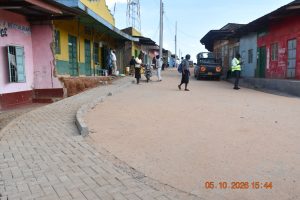
Installation of Paving blocks at Kaanwa Market

 Installation of paving blocks for a distance of  400  Meters  paving around the Kaanwa market

The municipality will benefit from parking rates collection and improve the accessibility to the busy Kaanwa Market

Embu Municipality
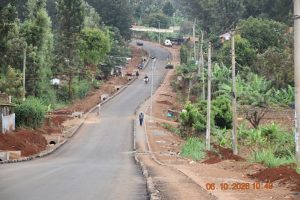
Kamiu Road


One of the success projects being implemented at Embu Municipality on Upgrading of Kamiu road to Bitumen standards

Phase one of, 1.1 Km on Upgrading of Kamiu Road to bitumen Standards, a high volume, road meant to decongest Embu – Meru National highway that connects Kiritiri to KSG  Meru- Embu National highway road .Also included in the project is provision of NMT Street lighting and drainage

The road will boost and spur economic growth along the road and the urban areas .

Muranga Municipality
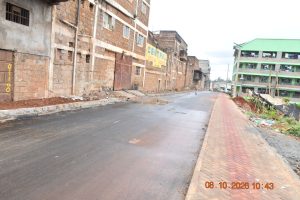
Upgrading Standards of PCEA- Kayole Road to Bitumen Standards Muranga Municipality

The project has so far opened the access road improving the security and livelihood of people living around the area.

Kenol Municipality

 

KWFT – Posta paving blocks of 127 meters by 12 meters of interlocking blocks at Kenol Municipality

The Municipality has boosted its revenue by the collection of parking fees from the project